Classical
Provided are two exemplary samples of classical music along with the extracted explanations. The standard heatmap specifies the local explanation as obtained with standard LRP. The subspace heatmaps represent the disentangled explanation-components as extracted with DRSA and LRP. In order to enable good visual inspection, the audio players for each explanation are provided in collapsible sections below the figure.
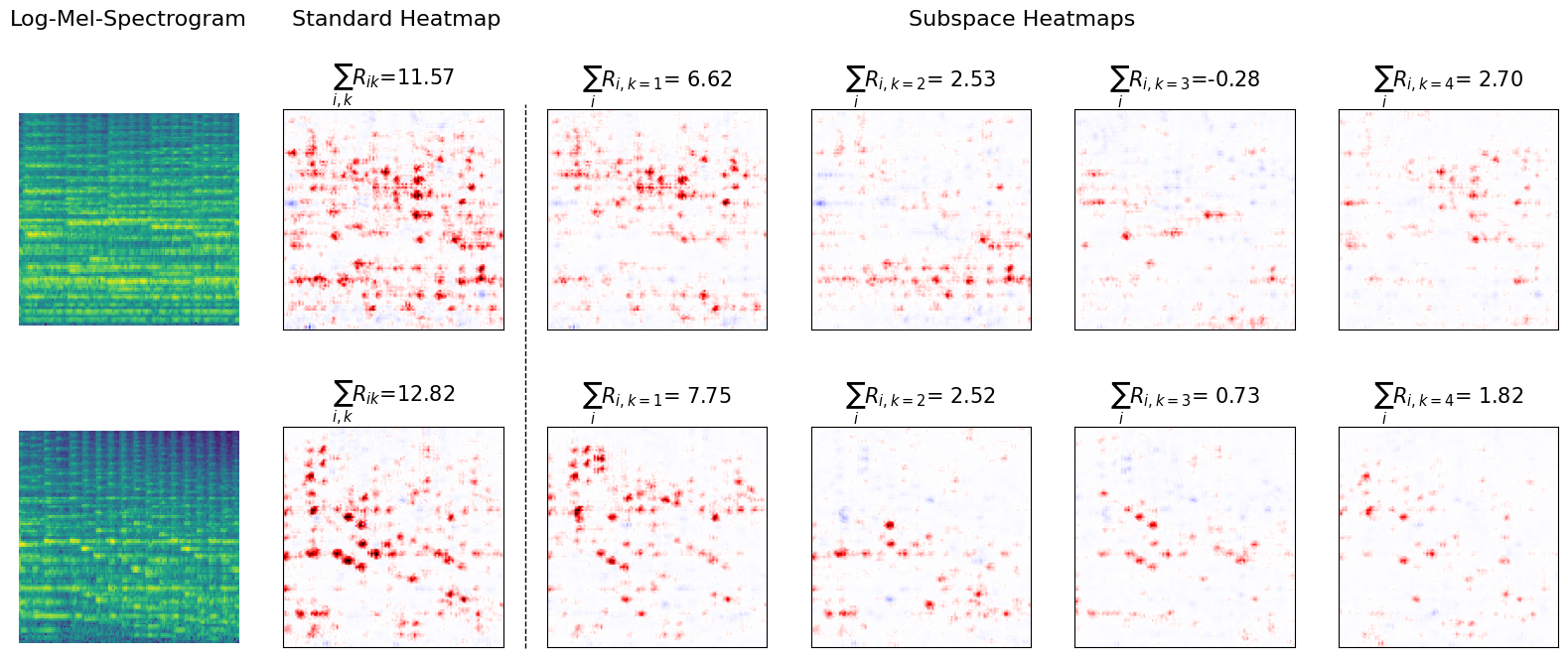
Extracted Concepts
The model learned these distinct concepts when classifying this genre:
Core Rhythm / Groove
Strongly predictive and repetitive rhythmic patterns that define the foundational pulse of classical compositions.
Percussive Detail
Encodes articulation and attack characteristics, capturing the precise timing and dynamics of instrumental onsets.
Melody / Pitch Motion
Sparse, task-dependent melodic contours and pitch progressions that carry the thematic material.
Harmony / Timbre
Encodes spectral structure including harmonic progressions and the characteristic timbral quality of classical instrumentation.
Audio Samples & Explanations
Click on each sample to expand and listen to the original audio, standard LRP explanation, and the four disentangled concept explanations.
Original & Standard Explanation
Disentangled Explanation Components